
Behind the Scenes of Car Horn Testing Experiments
Few drivers consider the rigorous testing behind every horn. Our factory's quality control process ensures every unit meets exacting standards before reaching your vehicle.
Each horn undergoes 27 separate tests across 3 phases, with our 98.7% first-pass quality rate resulting from precision equipment that measures sound characteristics within 0.1dB accuracy and response times to 1/1000th of a second.
Let me walk you through our comprehensive testing procedures that guarantee reliability.
Laboratory Equipment Introduction – High-Precision Testing Environment
Our testing facility resembles a scientific laboratory more than a factory. The equipment investment exceeds $2 million annually.
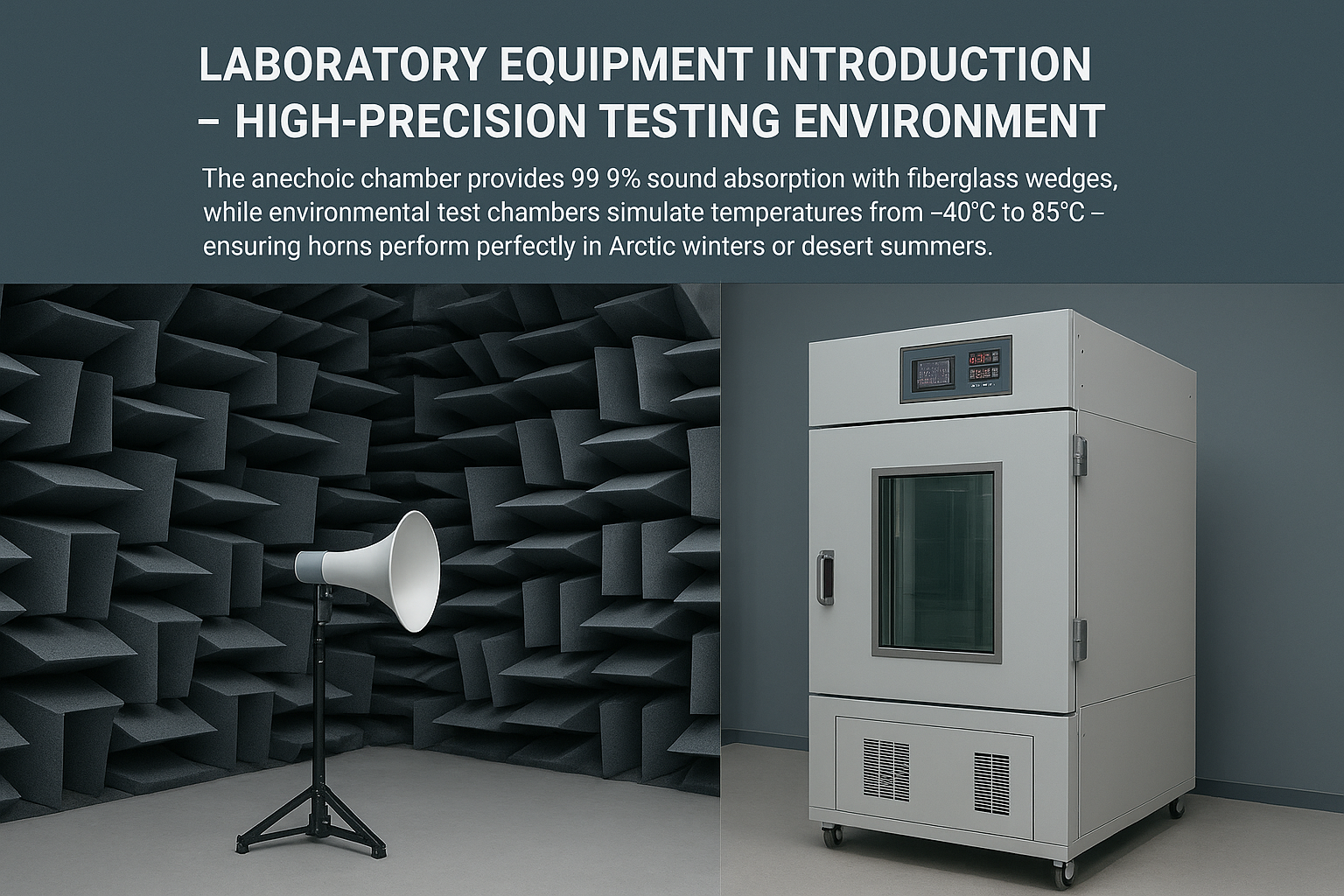
The anechoic chamber provides 99.9% sound absorption with fiberglass wedges, while environmental test chambers simulate temperatures from -40°C to 85°C - ensuring horns perform perfectly in Arctic winters or desert summers.
Core Testing Equipment Breakdown
-
Sound Measurement Systems: Equipment Purpose B&K 2270 Sound Analyzer Frequency response ±0.15dB GRAS 46AE Microphones Pressure measurement ±0.2dB Head Acoustics Artemis Directional analysis 0.1° resolution -
Environmental Testers:
- Weiss Technik climate chambers (±0.5°C)
- Salt spray corrosion tester (ASTM B117)
- Vibration table (5-2000Hz range)
- IP65 waterproof testing booth
-
Electrical Test Systems:
- Chroma 19032 Power Analyzer
- CAN bus simulation interface
- 100,000-cycle endurance tester
Acoustic Data Acquisition – Measuring Sound Quality and Response Speed
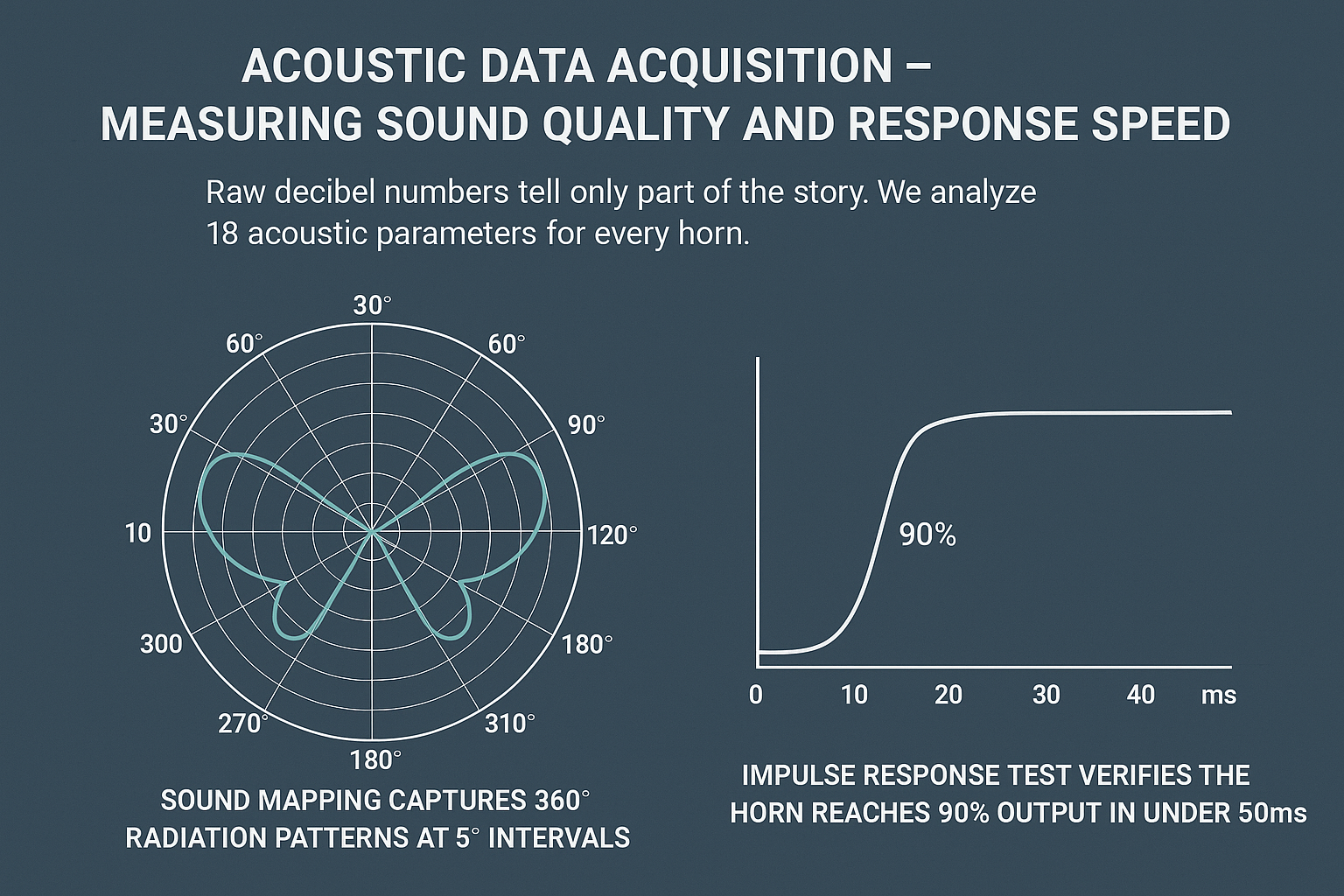
Raw decibel numbers tell only part of the story. We analyze 18 acoustic parameters for every horn.
Our sound mapping captures 360° radiation patterns at 5° intervals, while the impulse response test verifies the horn reaches 90% output in under 50ms - crucial for emergency situations where every millisecond counts.
Key Performance Metrics
-
Sound Quality Analysis: Parameter Test Method Fundamental frequency FFT analysis ±3% of nominal Total harmonic distortion 1kHz sine wave <5% THD Directional consistency 72-point measurement ±2dB variance -
Response Time Testing:
- Activation delay: <10ms
- Full output rise time: <50ms
- Decay time: <100ms
- Continuous operation: 30s bursts
-
Real-World Simulation:
- Urban noise background (70dB)
- Highway wind noise (85dB)
- Rain conditions (water spray)
- Engine vibration patterns
Innovation and R&D Story – The Efforts Behind the Technology
Our engineering team has filed 14 patents in the past 5 years. Each innovation solves real-world problems reported by drivers.
The breakthrough dual-coil electromagnetic design came after analyzing 327 failed horns from Middle Eastern markets - it now withstands 150°C temperatures while reducing power consumption by 22%.
Notable Engineering Challenges Solved
-
Extreme Climate Adaptation:
- Desert heat: Ceramic-coated diaphragms
- Arctic cold: Low-temp lubricants
- Tropical humidity: Nano-coated PCBs
- Coastal salt: Stainless steel fasteners
-
Material Science Advances: Component Innovation Diaphragm Titanium alloy 40% longer life Coil Oxygen-free copper 15% better conductivity Housing Glass-reinforced nylon 60°C higher HDT -
Quality Control Milestones:
- 2019: Implemented automated optical inspection
- 2021: Introduced AI-based sound analysis
- 2023: Achieved IATF 16949 certification
- 2024: Launched blockchain traceability
Conclusion
Every horn represents hundreds of hours of testing. For OEM-grade quality assurance, contact info@jindongauto.com.
Our Commitment: All products come with 2-year warranties and full test documentation. Visit www.jingdongparts.com for technical white papers.