

Every driver needs a reliable warning system. Modern electric horns can match compressor models in volume while being more compact and maintenance-free.
Electric car horns achieve 110-130dB loudness through electromagnetic vibration systems that don't require air compressors, using tuned diaphragms and resonance chambers to amplify sound.
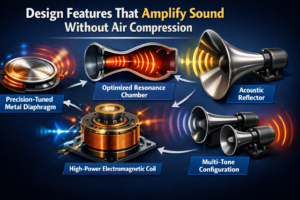
Design Features That Amplify Sound Without Air Compression
Electric horns create impressive volume through clever engineering rather than compressed air. The secret lies in their specialized components working in harmony.
Key amplifying elements include:
- Precision-tuned metal diaphragms
- Optimized resonance chambers
- High-power electromagnetic coils
- Acoustic reflectors
- Multi-tone configurations
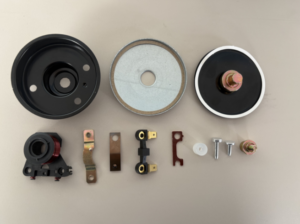
Sound Amplification Mechanisms
| Component | Function | Impact on Volume |
|---|---|---|
| Diaphragm | Vibrates at set frequency | Determines base loudness |
| Coil | Creates magnetic pulses | Controls vibration strength |
| Chamber | Resonates sound waves | Amplifies specific frequencies |
| Reflector | Directs sound forward | Increases perceived loudness |
| Housing | Dampens unwanted vibrations | Focuses clean sound output |
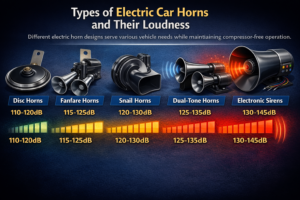
Types of Electric Car Horns and Their Loudness
Different electric horn designs serve various vehicle needs while maintaining compressor-free operation. Understanding these types helps select the right warning system.
Main electric horn categories:
- Disc horns (110-120dB)
- Fanfare horns (115-125dB)
- Snail horns (120-130dB)
- Dual-tone horns (125-135dB)
- Electronic sirens (130-145dB)
Electric Horn Performance Comparison
| Type | Typical dB | Frequency | Power Usage | Best For |
|---|---|---|---|---|
| Basic Disc | 110-115 | Single tone | 5A | Compact cars |
| Premium Disc | 115-120 | Dual tone | 6A | Sedans/SUVs |
| Fanfare | 120-125 | Broad range | 8A | Trucks |
| Snail | 125-130 | Focused beam | 10A | Commercial |
| Dual Snail | 130-135 | Dual frequency | 12A | Emergency |
Factors Affecting Volume: Voltage, Material, and Placement
Several technical aspects determine how loud an electric horn sounds in real-world conditions. Optimizing these factors ensures maximum effectiveness.
Critical volume influencers:
- Operating voltage (12V vs 24V systems)
- Diaphragm material (steel vs titanium)
- Resonance chamber size
- Horn mounting position
- Environmental conditions
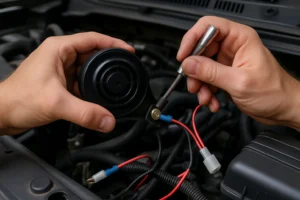
Volume Optimization Factors
| Factor | Effect | Improvement Method |
|---|---|---|
| Voltage | Higher = louder | Use voltage stabilizer |
| Material | Stiffer = sharper | Titanium diaphragms |
| Chamber | Larger = deeper | Custom enclosures |
| Placement | Open area = better | Front grille mount |
| Wiring | Thicker = stronger | 10-gauge cables |
Conclusion
Modern electric horns deliver compressor-level volume through advanced electromagnetic systems, offering reliable warning tones without complex air systems.
TIAN
FHL GBSY JS-TECH Automotive Safety
info@jindongauto.com
www.jingdongparts.com
Precision Engineering · Safety First · Reliable Performance