
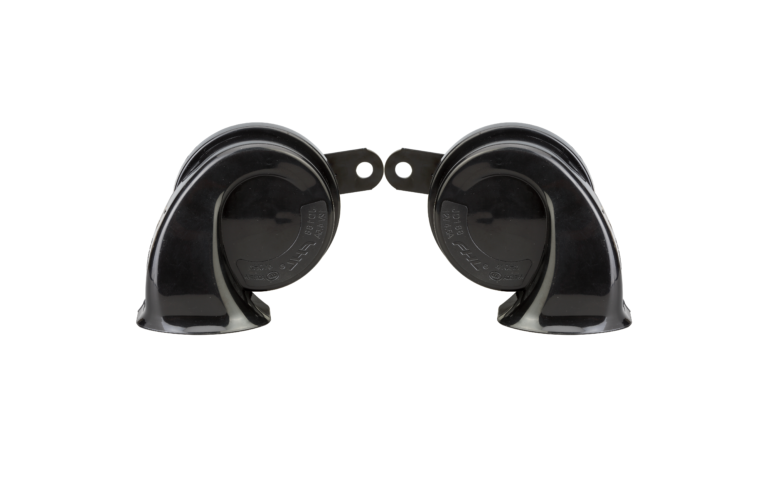
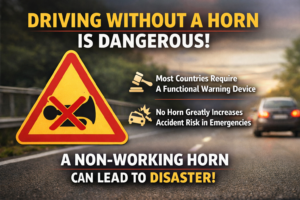
Imagine needing to warn another driver but your horn doesn't work - this dangerous situation is more serious than most drivers realize.
While no universal law prohibits driving without a working horn, most countries require functional warning devices, and driving without one significantly increases accident risks in emergency situations.
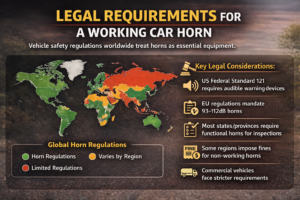
Legal Requirements for a Working Car Horn
Vehicle safety regulations worldwide treat horns as essential equipment. The specific requirements vary by location but share common safety principles.
Key legal considerations:
- US Federal Standard 121 requires audible warning devices
- EU regulations mandate 93-112dB horns
- Most states/provinces require functional horns for inspections
- Some regions impose fines for non-working horns
- Commercial vehicles face stricter requirements
Horn Requirements by Region
| Country | Minimum dB | Required By Law | Inspection Check | Fine Amount |
|---|---|---|---|---|
| USA | 93dB | Yes | State-dependent | $25-$100 |
| UK | 98dB | Yes | MOT Test | £100 |
| Germany | 105dB | Yes | TÜV | €50 |
| Japan | 90dB | Yes | Shaken | ¥7,000 |
| Australia | 95dB | Yes | Roadworthy | $150 |
Safety Risks of Driving Without a Horn
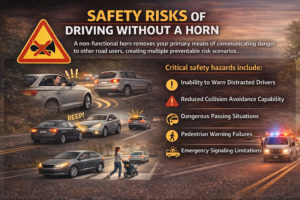
A non-functional horn removes your primary means of communicating danger to other road users, creating multiple preventable risk scenarios.
Critical safety hazards include:
- Inability to warn distracted drivers
- Reduced collision avoidance capability
- Dangerous passing situations
- Pedestrian warning failures
- Emergency signaling limitations
Accident Risk Comparison
| Scenario | With Horn | Without Horn | Risk Increase |
|---|---|---|---|
| Lane Drift | 80% Avoidance | 30% Avoidance | +167% |
| Pedestrian | 90% Warning | 10% Warning | +800% |
| Intersection | 75% Alert | 20% Alert | +275% |
| Parking Lot | 85% Signal | 15% Signal | +467% |
| Animal | 70% Scare | 5% Scare | +1300% |
What to Do If Your Car Horn Stops Working
When your horn fails, immediate action helps restore this critical safety feature while maintaining legal compliance.
Recommended repair steps:
- Check fuse/relay first (common issue)
- Test horn button/clock spring
- Inspect wiring connections
- Verify horn ground connection
- Consider professional diagnosis

Horn Troubleshooting Guide
| Symptom | Likely Cause | DIY Fix | Professional Needed |
|---|---|---|---|
| No sound | Blown fuse | Replace fuse | If recurring |
| Intermittent | Bad relay | Swap relay | Wiring check |
| Weak sound | Dying horn | Clean contacts | Replace horn |
| Constant on | Stuck button | Disconnect | Clock spring repair |
| Buzzing | Bad ground | Clean terminal | Wiring harness |
Conclusion
While technically possible to drive without a horn, doing so violates safety regulations and dramatically increases accident risks - prompt repair is essential.
TIAN
FHL GBSY JS-TECH Automotive Safety
info@jindongauto.com
www.jingdongparts.com
Precision Engineering · Safety First · Reliable Performance