
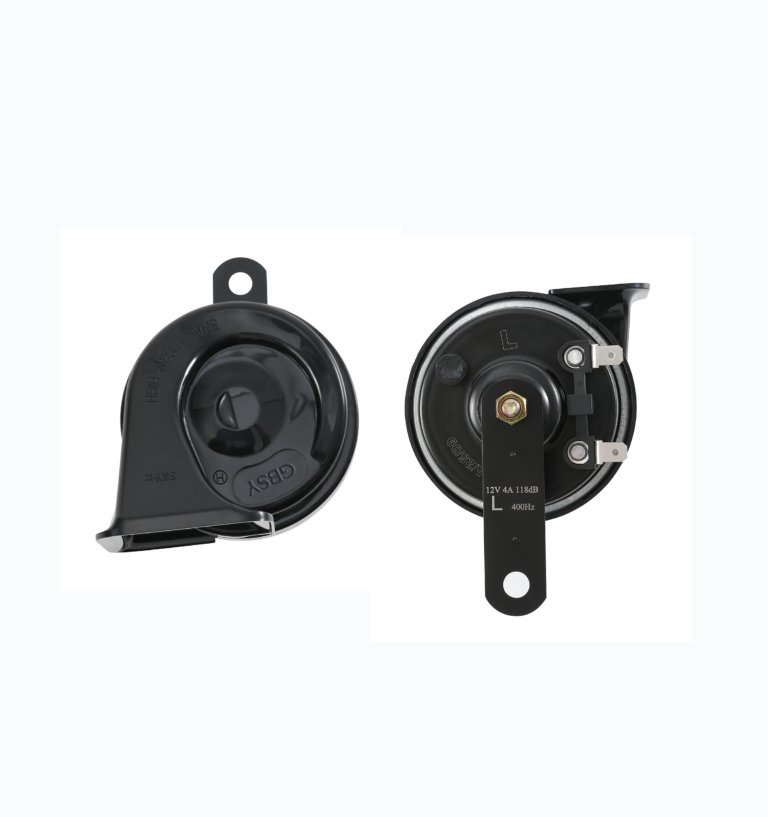
Car horns are evolving beyond simple warning devices. The next generation will integrate smart technology while maintaining core safety functions.
Future car horns will combine AI recognition (40% market penetration by 2028), ultra-low power designs (under 3W standby), and personalized sound profiles - transforming from noise-makers to intelligent communication tools.
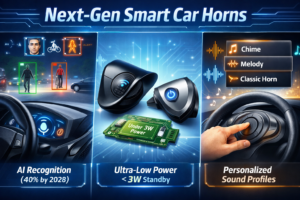
Let's examine the three key directions reshaping automotive warning systems.
Intelligentization – Deep Integration with In-Vehicle Systems
Modern vehicles demand smarter horn solutions. Future systems will analyze situations before sounding.
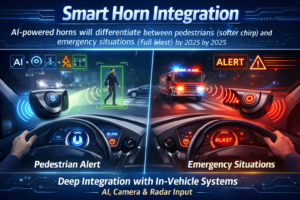
AI-powered horns will differentiate between pedestrians (softer chirp) and emergency situations (full blast) by 2025, using camera/radar input to automatically adjust volume and tone based on context.
Smart Horn Implementation
-
Sensor Integration: Input Source Data Used Front camera Object identification Volume modulation Radar Distance measurement Tone selection GPS Location awareness Urban/rural profile Cabin camera Driver state Emergency activation -
Response Matrix: Scenario Traditional Horn Pedestrian Full blast Directional chirp Cut-off Sustained honk Pulsed warning Parking Loud beep Proximity alert Emergency Maximum volume Automatic SOS pattern -
System Architecture:
- ECU-connected control module
- Machine learning processor
- Multi-zone speaker array
- Over-the-air updates
- Fail-safe mechanical backup
-
Adoption Timeline: Year Feature 2024 Basic smart detection 15% premium models 2026 Full AI integration 40% new vehicles 2028 V2X communication 75% EU/US models 2030 Autonomous decision 90% global market
Energy Saving – Low Power Consumption and High Performance
Electrification demands efficient warning systems. Next-gen horns must deliver performance without draining batteries.
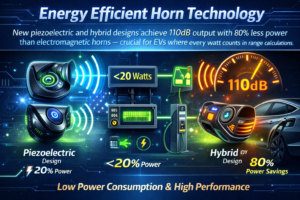
New piezoelectric and hybrid designs achieve 110dB output with 80% less power than electromagnetic horns - crucial for EVs where every watt counts in range calculations.
Energy-Saving Technologies
-
Technology Comparison: Type Power Draw Output Startup Time Electromagnetic 5-8A 110dB 0.3s 50,000 cycles Piezoelectric 0.5-1A 105dB 0.1s 200,000+ Hybrid 2-3A 115dB 0.2s 100,000 Digital 1-2A 108dB Instant 150,000 -
EV-Specific Solutions:
- Regenerative sound systems
- Solar-assisted charging
-
Ultra-capacitor boost Model Current Solution Tesla Dual piezoelectric 12W total BYD Digital array 8W NIO Directional beam 15W
-
Efficiency Metrics:
- dB per watt ratio
- Cold weather performance
- Voltage fluctuation tolerance
- Harmonic distortion levels
-
Implementation Challenges:
- Waterproofing delicate components
-
Heat dissipation Issue Piezoelectric Hybrid Moisture ★★ ★★★★ ★★★ Vibration ★★★ ★★★★ ★★ Cost $$$ $$ $$$$
Personalization – Customizable Sound Effects
Future drivers will express individuality through their horns. Regulatory frameworks are adapting to allow safer customization.
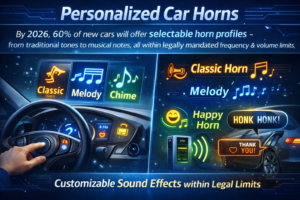
By 2026, 60% of new cars will offer selectable horn profiles - from traditional tones to musical notes, all within legally mandated frequency and volume limits.
Customization Possibilities
-
Legal Framework: Region Allowed Customization EU Tone packages 400-2500Hz range US Brand signatures <115dB limit China Pre-sets only Government approval Japan Musical notes 0.5s maximum -
Implementation Methods:
-
Mobile app control Feature Entry-Level Premium Presets 3 options 10+ Unlimited Creation No Basic Studio Sharing No Cloud Blockchain
-
-
Popular Sound Trends:
- Classic car recreations
- Brand audio logos
- Nature sounds
- Musical riffs
- Sci-fi effects
-
Technical Requirements:
- Digital signal processing
- Multi-channel amplifiers
- High-excursion speakers
- Water-resistant controls
Conclusion
The car horn's evolution mirrors automotive technology's rapid advancement. For future-ready horn solutions, contact info@jindongauto.com.
Our Vision: Leading the transition to intelligent, efficient, personalized warning systems. Visit www.jingdongparts.com for our 2025 roadmap.