
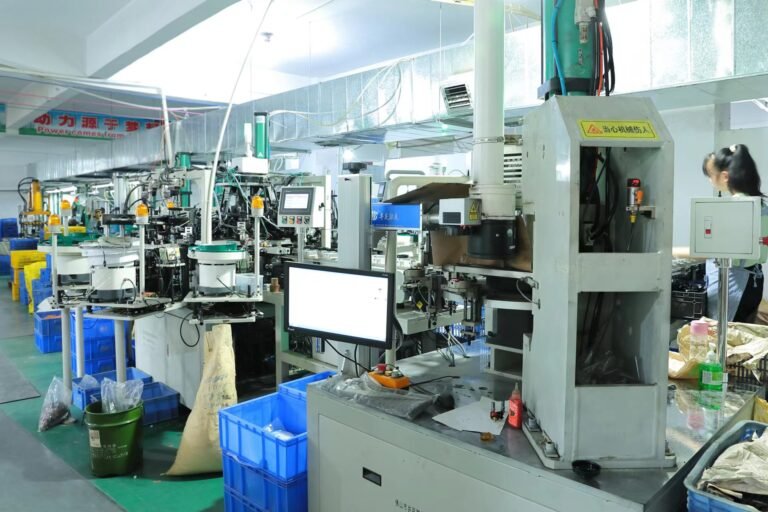
In today’s fast-growing global auto market, the quality and performance of auto horns, a critical safety component, directly affect driving safety and user experience. Located in China, Jindong Horn Factory has become a leading company in the industry thanks to its advanced production equipment and strict quality control systems. This article will give you a detailed introduction to the production process of auto horns at Jindong Horn Factory.
Coil Workshop: Efficient Mechanized Production
The first step in the production process is conducted in the coil workshop. In this workshop, we use highly mechanized production equipment to wind coils according to standard specifications. Coils are one of the core components of auto horns. The quality of the coils directly affects the sound quality and durability of the horns. The advantage of mechanized production is that it can ensure the winding precision and consistency of each coil, ensuring the stable performance of the horns. In addition, automated equipment can work continuously for 24 hours, greatly improving production efficiency.
Semi-Automated Assembly of Base Components
After the coils are wound, the next step is to assemble the base components. The main components of the base are PA66 nylon new material, coils, insulation plates, and rods. In this stage, Jindong Horn uses a semi-automated production method. We combine mechanical automation with manual assembly to improve production efficiency while ensuring assembly precision and quality.
First Sound Test: Ensuring Initial Quality
After the base components are assembled, the horns go through the first sound test. In this step, each horn that is preliminarily assembled will be tested for sound to see if it meets the standard. If it doesn’t meet the standard, it will be sent back for rework. This step ensures that each horn meets the basic sound quality requirements before moving on to the next production step. The sound test usually uses professional acoustic testing equipment to measure the sound frequency, loudness, and quality of the horn to see if it meets the design standard. During the test, the technician compares the actual test data with the standard data in real time to find and correct problems promptly.
Installing the Housing and Second Sound Test
After passing the first sound test, the horn will move on to the housing installation. The housing not only protects the internal components but also affects the sound quality of the horn. Therefore, after the housing is installed, we will conduct the second sound test. This step is to check whether the housing installation will affect the sound quality of the horn. We need to confirm that the horn can still produce clear and loud sounds.
Housings are usually made of a strong plastic or metal material that has excellent shockproof and waterproof performance. During the installation process, we need to ensure that the housing is tightly combined with the internal components without looseness or misalignment.
Gluing and Third Sound Test: The Key to Waterproof Breathable Membranes
After confirming the housing installation, we will glue the waterproof breathable membrane. The membrane can prevent moisture from entering the horn, protecting the electronic components inside while maintaining the breathability and sound quality of the horn. After gluing, we will conduct the third sound test. This step is to check whether the installation of the waterproof breathable membrane will affect the normal operation of the horn.
Packaging and Quality Assurance
Once the horn has passed all tests, it will be ready for the final packaging. In the packaging stage, Jindong Horn Factory has strict quality control measures to ensure that each horn leaving the factory has completed the entire production and testing process and meets the factory’s standards. After the horns are packaged, they will be stored in the warehouse or shipped directly to customers.
The packaging materials we use are high-quality shock-proof and moisture-proof cartons to ensure that the horns will not be damaged during transportation. Each packaging box is marked with the product information, including production batch numbers and quality inspection marks, to facilitate traceability and management.
The Importance of Three Sound Tests
Throughout the entire production process, Jindong Horn Factory pays special attention to the consistency of horn sound effects. We perform three sound tests at the three stages of the horn production process: the initial assembly of the base components, the installation of the housing, and the gluing process. We test the sound at each stage to ensure that each horn we produce can emit consistent and high-quality sound. This will not only improve the quality of the product, but it will also increase the trust and satisfaction of the users.
To ensure the consistency of the sound, we carefully record and analyze the test data at each stage. If any problems are found, we will trace back to the production process to find and solve the problem in time.
Conclusion
Although the production process of auto horns may seem simple, each step requires careful work and strict quality control. Jindong Horn Factory uses advanced mechanized production equipment and scientific production processes to ensure that each horn we produce meets high-quality standards. From coil winding to three sound tests, each step is done with precision. This demonstrates Jindong Horn’s strength and leadership in the auto horn manufacturing industry. In the future, Jindong Horn will continue to focus on technological innovation and quality improvement, providing high-quality auto horn products to users around the world.