

Car horns must balance attention-getting power with hearing safety. Understanding decibel levels helps choose the right horn for different driving conditions.
Car horns typically operate between 100-110dB at 2 meters - loud enough to penetrate traffic noise while staying below the 120dB pain threshold. Frequency distribution between 400-800Hz ensures optimal human ear sensitivity.
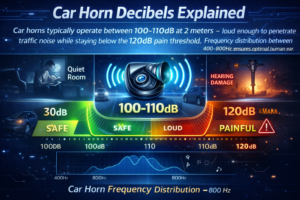
Let's examine how sound measurement, frequency, and environment affect horn effectiveness and hearing safety.
Decibel Basics – Measuring Sound Volume
Decibels measure sound intensity logarithmically, not linearly. This means small number changes represent significant loudness differences.
A 10dB increase doubles perceived loudness - making a 110dB horn sound twice as loud as 100dB, while 120dB approaches pain threshold and risks hearing damage with prolonged exposure.

Decibel Reference Guide
-
Common Sound Levels: dB Level Sound Example 30 Whisper Unlimited 60 Normal conversation Unlimited 85 Heavy traffic 8 hours 100 Motorcycle 15 minutes 110 Car horn <1 minute 120 Siren Instant pain -
Horn Output Measurement:
- Measured at 2 meters distance
- Tested with engine off
- 90° angle to horn
- In open air environment
- Using Class 1 sound meter
-
Distance Attenuation: Distance 2m 0 (reference) 4m -6dB 8m -12dB 16m -18dB -
Legal Requirements: Country Minimum dB USA 93 112 EU 96 104 China 95 110 Japan 90 105
The Influence of High and Low Frequencies on Hearing Experience
Frequency determines how easily we hear sounds. The human ear detects mid-range frequencies best, especially in noisy environments.
Horns between 400-800Hz penetrate traffic noise most effectively - lower frequencies travel farther but require more power, while higher frequencies are directional but irritating.

Frequency Performance Analysis
-
Human Hearing Sensitivity: Frequency Range Perception 200-400Hz Less sensitive Long-distance 400-800Hz Most sensitive Urban use 800-1200Hz Directional Highway 1200Hz+ Harsh Emergency -
Frequency vs Environment: Driving Condition Ideal Frequency City traffic 500-700Hz Cuts through noise Highway 600-800Hz Over wind noise Rural areas 400-600Hz Long-distance Parking 800-1000Hz Precise location -
Tone Quality Factors:
- Harmonic content
- Attack time
-
Sustain characteristics Tone Type Frequency Mix Single Pure tone Penetrating Dual Two tones Attention-getting Chord Multiple Distinctive
-
Age-Related Hearing Impact: Age Group Best Frequency Range <30 20-16000Hz Minimal 30-50 30-15000Hz -5dB at 4kHz 50+ 50-12000Hz -15dB at 4kHz
Decibel Selection Recommendations for Driving Environments
Choosing the right horn volume requires balancing audibility with noise pollution concerns. Different situations demand different approaches.
Urban drivers need 105-110dB horns to overcome traffic, while rural areas benefit from 100-105dB - always consider local noise regulations and typical driving conditions.
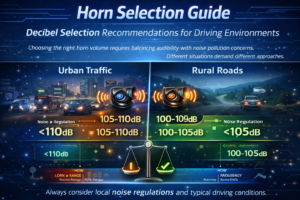
Environment-Specific Recommendations
-
Volume by Vehicle Type: Vehicle Recommended dB Frequency Compact car 100-105 500-700Hz Space limitations SUV/Truck 105-110 400-600Hz Larger cabin Motorcycle 110-115 600-800Hz Wind noise Commercial 115-120 400-500Hz Emergency use -
Geographic Considerations: Location Suggested dB Legal Limit European cities 100-103 104dB Dual-tone US highways 105-110 112dB Loud single Asian urban 103-107 110dB High-frequency Middle East 110-115 120dB Very loud -
Special Situations:
- Electric vehicles: 5dB louder than ICE equivalents
- Convertibles: +3-5dB for open-air driving
- Winter conditions: Choose horns with cold-weather performance
-
Safety vs Nuisance Balance: Factor Increase dB Heavy traffic ✓ Residential ✓ Poor visibility ✓ Night driving ✓
Conclusion
Understanding decibel science helps select the perfect horn. For professional-grade horns meeting all regulations, contact info@jindongauto.com.
Our Expertise: Scientifically-tuned horns for every environment. Visit www.jingdongparts.com for specifications.