
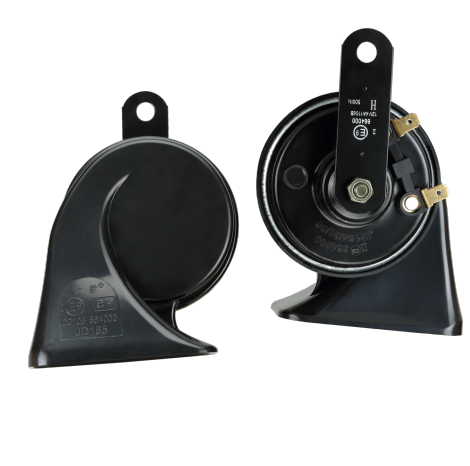
Have you ever noticed most cars actually have two horns? This dual-horn setup isn't just for redundancy - it serves crucial safety purposes every driver should understand.
Cars use two horns producing different frequencies (typically 500Hz and 405Hz) to create a penetrating dual-tone sound that cuts through traffic noise and is easier for human ears to locate.
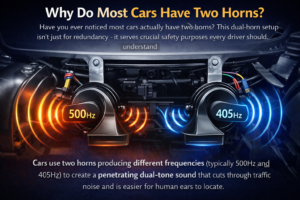
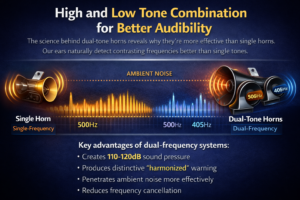
High and Low Tone Combination for Better Audibility
The science behind dual-tone horns reveals why they're more effective than single horns. Our ears naturally detect contrasting frequencies better than single tones.
Key advantages of dual-frequency systems:
- Creates 110-120dB sound pressure
- Produces distinctive "harmonized" warning
- Penetrates ambient noise more effectively
- Reduces frequency cancellation
- Provides clearer tone recognition
Dual-Tone Horn Performance Data
| Configuration | Frequency Pair | Sound Spread | Effective Range | Noise Penetration |
|---|---|---|---|---|
| Standard | 500Hz+405Hz | 180° | 50 meters | Good |
| Premium | 600Hz+420Hz | 210° | 70 meters | Excellent |
| Luxury | 550Hz+400Hz | 200° | 60 meters | Very Good |
| Performance | 650Hz+450Hz | 190° | 65 meters | Outstanding |
Safety Benefits of Dual-Horn Systems
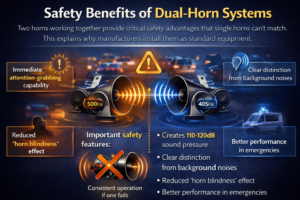
Two horns working together provide critical safety advantages that single horns can't match. This explains why manufacturers install them as standard equipment.
Important safety features:
- Immediate attention-grabbing capability
- Clear distinction from background noises
- Reduced "horn blindness" effect
- Better performance in emergencies
- Consistent operation if one fails
Single vs Dual Horn Safety Comparison
| Feature | Single Horn | Dual Horn | Advantage |
|---|---|---|---|
| Attention | Moderate | High | +40% |
| Direction | Unclear | Precise | Easier to locate |
| Failure Rate | 100% if fails | 50% if one fails | More reliable |
| Noise Penetration | Fair | Excellent | Works in traffic |
| Recognition | Standard | Distinctive | Less confusion |
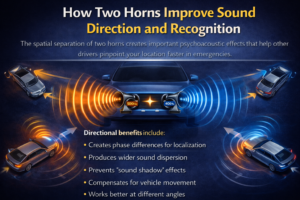
How Two Horns Improve Sound Direction and Recognition
The spatial separation of two horns creates important psychoacoustic effects that help other drivers pinpoint your location faster in emergencies.
Directional benefits include:
- Creates phase differences for localization
- Produces wider sound dispersion
- Prevents "sound shadow" effects
- Compensates for vehicle movement
- Works better at different angles
Horn Placement Optimization Guide
| Position | Separation | Effectiveness | Recommended For |
|---|---|---|---|
| Front Left/Right | 30cm | Excellent | Most vehicles |
| Upper/Lower | 20cm | Good | Compact cars |
| Diagonal | 25cm | Very Good | SUVs/Trucks |
| Vertical | 15cm | Fair | Limited space |
| Single Side | N/A | Poor | Not recommended |
Conclusion
Dual-horn systems provide critical safety advantages through superior sound projection, directionality, and reliability that single horns simply can't match.
TIAN
FHL GBSY JS-TECH Automotive Safety
info@jindongauto.com
www.jingdongparts.com
Precision Engineering · Safety First · Reliable Performance